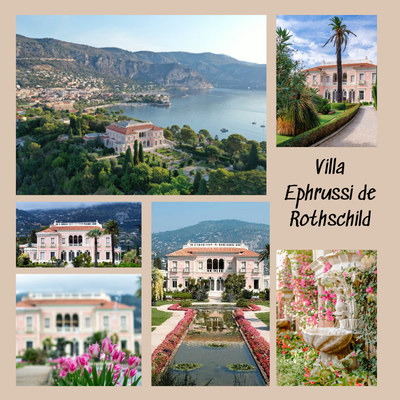
Cap Ferrat, Where the Belle Époque Still Breathes
There are places along the French Riviera where time does not simply pass - it dissolves. Belle Époque is one of those rare historical eras that still lingers here, not as memory, but as atmosphere: soft light on pastel façades, the quiet elegance of palm-lined promenades, and villas that feel more like dreams than architecture.
Among them, one stands apart - not only for its beauty, but for the extraordinary woman who created it.
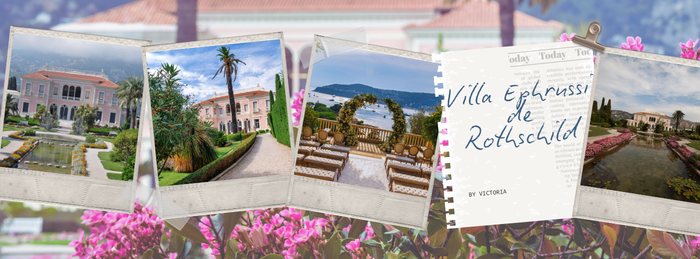
On the sun-drenched peninsula of Saint-Jean-Cap-Ferrat, overlooking the Mediterranean, rises the Villa Ephrussi de Rothschild, the masterpiece of Béatrice Ephrussi de Rothschild. Born into the legendary Rothschild banking dynasty, Béatrice was raised in a world where wealth and refinement were not aspirations, but birthrights. Yet what defined her was not privilege - it was obsession: an uncompromising devotion to beauty.
From childhood, she collected art, porcelain, furniture, and rare objects with the instinct of someone who did not simply admire beauty, but needed to live inside it. Her life, however, was not shaped by privilege alone. A marriage arranged for power and status quickly turned into personal confinement, marked by emotional distance and betrayal. When it ended in divorce, Béatrice did not retreat - she rebuilt herself.
And she did so by building a world.
In 1905, she discovered a wild, rocky stretch of land on Cap Ferrat. At the time, it was almost inaccessible - nothing more than a wind-swept promontory overlooking the sea. Where others saw emptiness, she saw possibility. She purchased the land immediately, and what followed was one of the most ambitious private architectural visions of the Belle Époque.
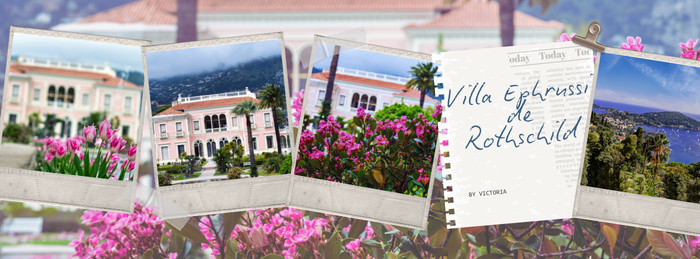
For seven years, between 1905 and 1912, the villa rose slowly from the cliffs. Architects came and went, plans were rejected, visions refined. Béatrice was famously uncompromising - every marble column, every tapestry, every piece of furniture had to meet her exacting standard of aesthetic perfection. The result was not simply a residence, but a living museum of European elegance.
Inside, the villa became a curated universe of aristocratic fantasy. Venetian marble floors, Louis XV furniture, Sèvres porcelain, Renaissance artworks, and rare antiques filled room after room. Béatrice even used the nearby railway station as a personal selection hall - having deliveries of art and furniture brought directly to her, where she chose pieces as they arrived, like treasures awaiting judgment.
But it is outside where the villa reveals its most poetic expression.
The gardens - nine in total - are not simply landscaped spaces, but emotional landscapes. Each one evokes a different world: the symmetry of the French formal garden, the serenity of the Japanese garden, the exoticism of the Spanish garden, the softness of Florentine inspiration. Together, they form a living symphony of design and imagination.
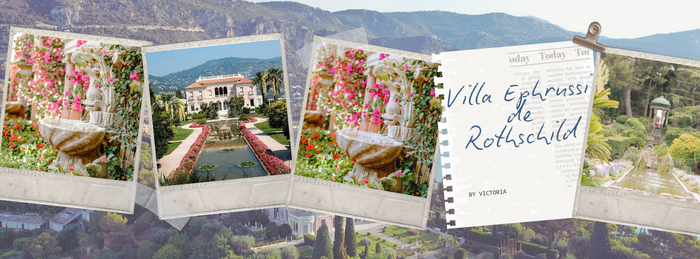
Creating them was an act of near madness and genius. The terrain had to be reshaped entirely. Soil was brought in by the thousands of tons. Workers carved terraces into rock, redirected wind patterns, and constructed illusions of nature that feel entirely organic today. What appears effortless is, in reality, one of the most engineered gardens in Europe.
For Béatrice, the villa was never a summer retreat. It was a living theatre of culture. She hosted intellectual salons, musical evenings, and artistic gatherings that attracted Europe’s elite - writers, collectors, musicians, and aristocrats who moved through her world like characters in a private opera.
After her death in 1934, the villa passed to the Institut de France, ensuring its preservation. Yet history was not kind in the years that followed. During World War II, the estate was looted and neglected, its gardens left to decay, its interiors stripped of much of their former brilliance.
And yet, like all true masterpieces, it survived.
Restoration efforts eventually returned much of its former grandeur, and today the Villa Ephrussi de Rothschild stands once again as one of the Riviera’s most extraordinary cultural treasures. Not frozen in time - but alive with it.
To walk through its salons is to step into a vanished world of elegance. To stand in its gardens is to feel how imagination can reshape nature itself. And to visit Cap Ferrat is to understand that the Belle Époque never truly ended here - it simply changed form.
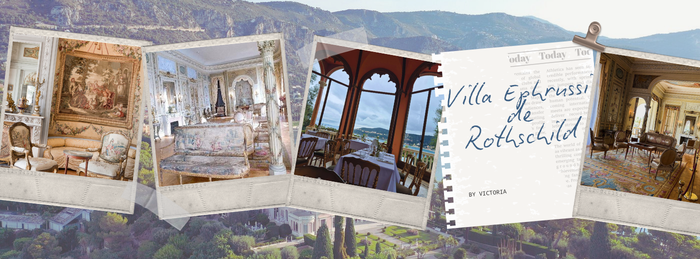
✨ This is not just a villa. It is a philosophy of beauty made stone, water, and light.
VillaHotels – curating the most extraordinary stories of the Riviera